
Case study
Giving a narrator's voice to every new script.
A long-form audio series needed new episodes read in its narrator's own voice, without a studio session each time. We built Voice Studio, a private studio that reads any script in their voice.
- Industry
- Media and audio
- What we built
- Voice Studio
- Services
- Custom AI models, product engineering
Narrator's voice
Episode script
CalmBreathe in slowly, and hold it for a count of three.
01
The challenge
A voice listeners know, in every episode.
The series wanted new episodes voiced without booking the narrator into a studio each time. Whatever replaced the session had to clear four bars.
- 1
It had to be them. Not a voice like the narrator's. Their voice, with their accent, from the first sentence to the last.
- 2
It had to last. Episodes run long, and synthetic voices tend to wander and flatten the longer they speak.
- 3
It had to feel human. Reflective audio lives in its pauses. A voice that simply recites the words loses the listener.
- 4
It had to stay private. A cloned voice is part of someone's identity, and it could never be exposed or misused.
02
How we solved it
Four problems. Four answers.
We didn't just pick a model. We shaped how it listens, reads and performs, the way a producer works with a narrator.
The problem
Sound like the narrator
What we did
A voice from one short recording.
The narrator records one short, clean clip. From that, the studio learns their voice and reads any new script in it, with no studio session needed.
The problem
Hold up over a long read
What we did
Read in natural phrases, at a steady pace.
Instead of reading a whole script in one breath, the studio works phrase by phrase, the way a narrator would, and keeps every line at the same comfortable pace.
The problem
Perform, not recite
What we did
An AI director for every script.
Before a word is spoken, a director reads the script and marks the feeling of each line and where to pause. It shapes the delivery and never changes the words.
The problem
Keep the voice safe
What we did
Private from end to end.
A cloned voice is part of someone's identity. The studio runs on infrastructure we control, and only the client's team can reach it.
See the director at work. Flip between the two.
Same script. Two ways to read it.
- Calm
Take a moment before the day begins.
- Soft
Let your shoulders drop,
- Soft
and notice the weight of your hands.
- Calm
Breathe in slowly,
- Calm
and hold it for a count of three.
- Relieved
Now let it go.
- Warm
Whatever is waiting for you can wait a little longer.
The director marks feeling and silence. It never changes a word.
Illustrative script.
03
How we built it
From one recording to a studio the team runs.
One small team took it from the first recording to a production studio, listening at every step.
Phase 1
Capture the voice
We coached the narrator through one short recording: a quiet room, their natural pace, and a mix of calm, upbeat and questioning lines so the model hears their full range.
Phase 2
Find the right model
We put several leading voice models through the narrator's real scripts and listened side by side, judging likeness, accent and how each held up on a long read. Only one made the cut.
Phase 3
Teach it to perform
We added the director, phrase-by-phrase reading and pace levelling, then tuned them by ear over many listening rounds until long reads sounded like a person, not a machine.
Phase 4
Make it production-ready
Everything was packaged to run on a private GPU server, with health checks, live monitoring and access limited to the team.
Phase 5
Hand it over
The studio runs in the cloud or on the team's own hardware, with setup scripts and a guide, so it keeps working long after launch.
04
Voice Studio
Inside Voice Studio.
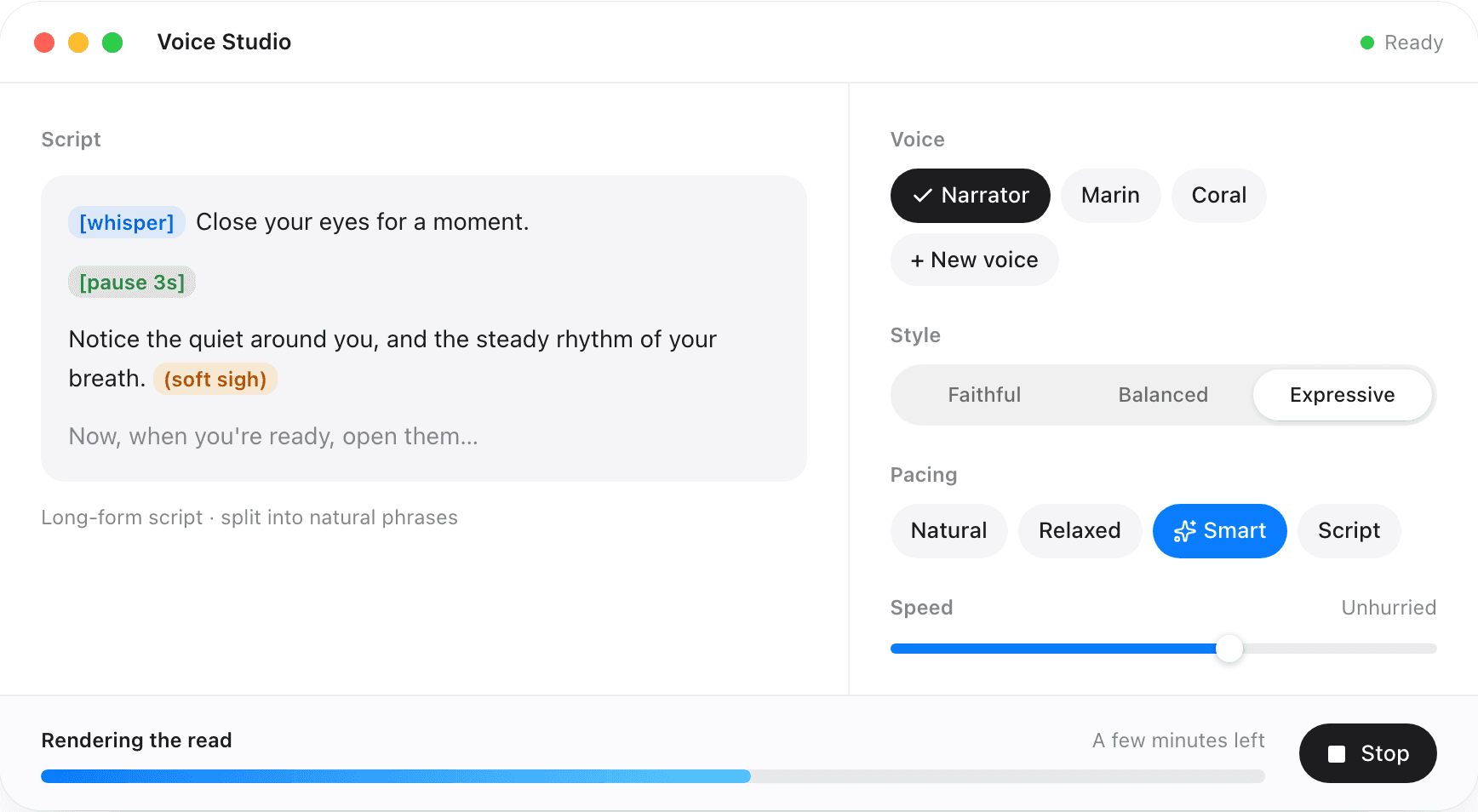
Paste a script, pick a voice, press generate. Anyone on the team can use it, with no audio engineering required.
What happens when you press generate.
- Script
- AI director
- Voice model
- Clean-up
- Finished audio
Voice library
The narrator's voice alongside ready-made studio voices. Preview any of them before you render.
Add a new voice
Drop in a short, clean clip. It's transcribed and tidied automatically, then ready to use.
Three styles
Faithful, Balanced or Expressive, from a steady read to a full performance.
Smart pacing
The AI director decides the feeling of each line and where a person would pause.
Script mode
Paste a production script as it is. Cues like whisper or pause are performed, notes are skipped.
Expressions
Add a laugh, a sigh or a softer tone exactly where the moment needs it.
Live progress
See each part of a long read render with an honest time estimate, and stop at any point.
Ready to publish
Optional clarity clean-up, a history of every take, and one-click download.
05
The outcome
Every new script can now be heard in the narrator's own voice, without booking a studio, and it sounds like them from the first line to the last.
Their voice, on demand. New episodes no longer wait for a recording session.
A delivery that breathes. Feeling and pauses are directed line by line, so long reads stay engaging.
Theirs to run. The studio can run in the cloud or on the team's own hardware.
Your turn
Have a voice worth scaling?
Narration, training content or a voice for your product. Tell us what it needs to say, and our engineers will tell you honestly what it takes.