
Case study
An ERP you can simply ask.
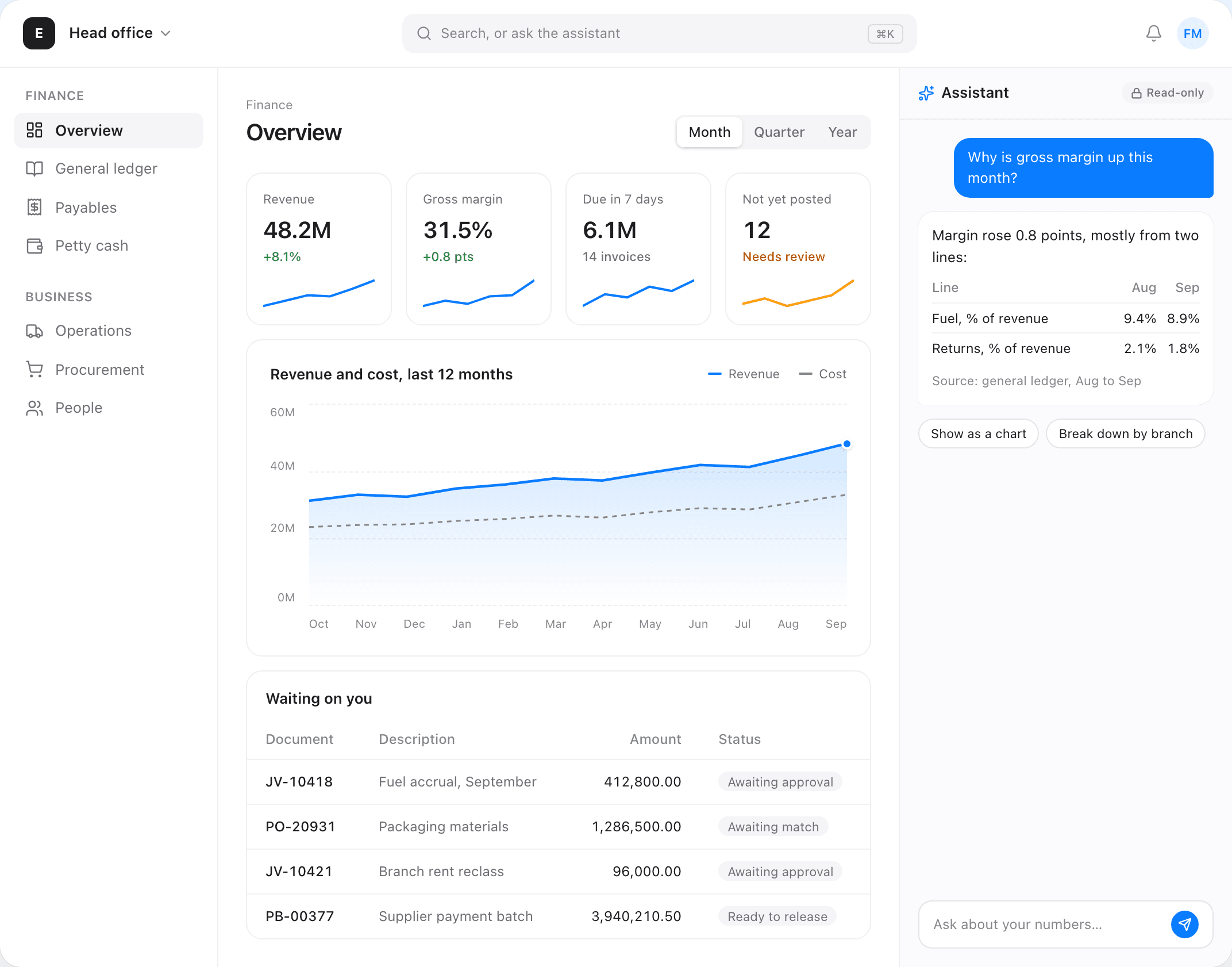
A growing delivery business needed one system for its finance, purchasing, people and operations. We built them an ERP with an AI assistant that answers questions from the live books, and can never change them.
- Industry
- Logistics and delivery
- What we built
- An AI-native ERP
- Services
- Product engineering, AI integration
01
The challenge
Growing fast, on tools that didn't talk.
Every new branch and supplier added more spreadsheets. The business needed a system it could trust, and one that answered back.
Like many fast-growing businesses, this one had outgrown its tools. As branches, suppliers and daily deliveries multiplied, each team found its own way to keep up, and the books, the orders, the deliveries and the payroll ended up in different places.
The cost showed up at month-end. Figures had to be carried between systems and checked against each other, and a manager with a simple question, such as how much is owed to a supplier or whether last month made money, had to wait for someone in finance to find the time.
Whatever replaced all of this had to meet four requirements.
- 1
One place for everything. Finance, purchasing, people and daily operations lived in separate tools and spreadsheets that never quite agreed.
- 2
Books an auditor would sign. Every entry balanced, every payment approved by the right people, every change on the record.
- 3
Answers without the hunt. Simple questions, like what we owe a supplier or how last month closed, meant someone digging through reports.
- 4
AI that can't touch the books. An assistant was welcome. One that could change a figure, or show someone data they shouldn't see, was not.
02
How we solved it
Four problems. Four answers.
A solid ERP first, then AI on top, in that order. The assistant is only as good as the books it reads.
The problem
Scattered systems
What we did
One ERP for the whole business.
Finance, procurement, HR and operations in a single system, with a portal where suppliers see their own statements and payments.
The problem
Financial control
What we did
Controls built into every flow.
Journals can't post unless they balance. Purchases need approvals from different people and must match the order, the delivery and the invoice before anyone is paid.
The problem
Questions waiting on reports
What we did
Ask in plain words, get the answer.
An assistant inside the ERP answers from the live books with a sentence, a table or a chart, and remembers what you're looking at so follow-ups just work.
The problem
Keeping AI safe
What we did
AI that reads, never writes.
The assistant can look things up but cannot create, approve or post anything. It signs in as the person asking and sees only what they're allowed to see.
Try the assistant. Pick a question.
Ask the ERP. Three example questions.
How has delivery revenue moved over the last six months?
ERP assistant
- Understanding the question
- Reading revenue from the ledger
- Drawing a chart
Revenue has grown in five of the last six months, with the strongest month in September.
Read-only. It answers from the books and never changes them.
Illustrative data.
03
How we built it
Books first. Then the brains.
We built it the way the business works: the accounting core, then each department, then the assistant on top.
Phase 1
Map every process
Before writing code, we sat with each team and wrote down how money, orders and people actually move through the business: purchasing, settlements, journals, petty cash, payroll and every approval in between. Each flow became a written guide with its rules, its approvers and the entries it should leave in the books. Those guides became the specification, the test plan and, later, the assistant's map of the business.
Phase 2
Build the accounting core first
Everything else depends on the ledger, so it came first: a chart of accounts, double-entry journals, accounting periods, cost centres and the core reports. Every report was tested against figures the team already knew before anyone relied on it.
Phase 3
Add each department on top
Procurement, operations, people and the supplier portal followed, one release at a time. Each module posts to the same ledger, so a delivery, a purchase or a payroll run shows up in the books without anyone re-keying it. Each module went into use while the next one was being built.
Phase 4
Give AI a safe window
With trustworthy books in place, we opened a read-only window for AI inside the ERP itself. It reuses the same sign-in, permission checks and report logic as the screens, so an answer from the assistant always matches what the person would see if they looked it up.
Phase 5
Teach the assistant, then open it up
We built the in-app assistant as a small team of AI agents and tested it against the questions the finance team actually asks. Because the window follows an open standard for AI tools, the team can also connect the general-purpose assistant they already use, with exactly the same safeguards.
04
Under the hood
The decisions that make it trustworthy.
Four choices shaped the system more than any others. Each one trades a little convenience for a lot of confidence in the numbers.
A
An accounting core that can't drift.
A journal that doesn't balance can't be posted: the rule is enforced by the system itself, not by a form. Accounting periods open and close, and a closed period stays closed, so a report run today for last quarter gives the same answer it gave last quarter.
Operations feed the books directly. When a delivery is completed, its revenue is recognised; when it's settled, the matching balances clear. A reconciliation check runs across the two and flags anything that happened in operations but hasn't reached the ledger yet, so gaps surface straight away instead of at month-end.
- Delivery completed
- Revenue recognised
- Settled
- General ledger
Reconciliation check. Compares operations with the ledger and flags anything that hasn't been posted yet.
B
Procure-to-pay, with the controls built in.
Every purchase follows one path, from a request to a posted payment. Approvals have to come from different people, competitive quotes are gathered before an order is placed, and nothing is paid until the order, the goods received and the supplier's invoice agree.
Payments go out in batches that finance reviews once, instead of one at a time. Suppliers see their own statements in a portal, so they can check a payment without calling finance.
- Request
- Two approvals
- Quotes
- Purchase order
- Goods received
- Invoice
- Three-way match
- Payment batch
- Posted
A control point. Nothing moves on until it passes.
C
How the assistant thinks.
A single first step reads the question, works out its language and intent, and decides which data it needs, all in one pass so answers come back quickly. The assistant then calls the same report functions the ERP's own screens use. It never writes its own database queries, so it can't invent a number or reach data it shouldn't.
It remembers what you're looking at. If a chart is open, 'show that by branch' or 'what about last quarter?' changes the chart instead of starting again. Simple lookups skip the AI model entirely and go straight to the books, which keeps them instant and free. Every answer records what it cost to produce, and questions that have nothing to do with the business get a polite no.
Understand
Reads the question, its language and intent, and picks the data it needs, in one pass.
Look it up
Calls the same read-only report functions as the ERP's screens.
Present
Chooses a sentence, a table or a chart, and remembers it for follow-ups.
Explain
Says what the numbers show, in plain words.
Stay on topic
Politely declines questions that aren't about the business.
Simple lookups skip the AI model and go straight to the books.
D
Safe by absence, not by instruction.
Telling an AI model 'never change the books' is a request, not a guarantee. So the window simply has no way to change anything: there are no tools to create, edit, approve or post. Whatever the AI is asked, the worst it can do is read.
What it can read is limited too. Each tool is mapped to a permission, and the AI signs in as the person asking, so it sees exactly what they could see on screen and nothing more. Every request starts fresh, so nothing carries over between people or sessions.
The assistant can
- Read reports and balances
- Look up suppliers and payments
- Draw tables and charts
Same sign-in and permissions as the person asking
No tool exists to
- Create or edit entries
- Approve anything
- Post to the ledger
- See data its user can't
05
Inside the ERP
Inside the AI ERP.
Every department in one place, and an assistant beside them that knows where every number lives.
What happens when you ask a question.
- Question
- Understand
- Choose the data
- Read the live books
- Answer, table or chart
Finance
General ledger, journals, profit and loss, balance sheet, cash flow and cost centres.
Procurement
Requests, quotations, purchase orders and three-way matching before payment.
People
Attendance, leave, rosters and payroll, connected to the same books.
Operations
Deliveries, returns and settlements, recognised as revenue automatically.
Supplier portal
Suppliers check their own balances and payments, without calling finance.
Approvals and audit
Role-based access, multi-step approvals and a full history of every change.
Ask in your language
Questions in other languages are translated, understood and answered.
Bring your own assistant
Connect a standard AI assistant to the ERP, read-only and permission-checked.
06
What we learned
Four things we'd do again.
What building AI into the system a business runs on taught us, and what we'll take into the next one.
- 1
Get the books right before adding AI. An assistant is only as trustworthy as the data under it. The months spent on the accounting core are what make its answers worth believing.
- 2
Let AI use the same doors as people. Reusing the screens' own report logic and permission checks meant no second version of the truth, and nothing new to secure.
- 3
Build safety into the design, not the prompt. Leaving write actions out entirely was simpler, and far safer, than instructing a model not to use them.
- 4
Context turns a chatbot into an analyst. Remembering the chart or table in front of you is what lets people explore their numbers the way they would with a colleague.
07
The outcome
A finance question no longer means a trip through the reports. Ask it in a sentence, and the answer comes from the live books, with the same controls as if you'd looked it up yourself.
One system of record. Every team works from the same numbers.
Answers on demand. Tables and charts in seconds, with follow-up questions that keep their context.
Safe by design. The AI can read what you can read, and can never change the books.
Your turn
Want an ERP that answers back?
Tell us how your business runs today. Our engineers will show you honestly what a system built around it, with AI you can trust, would take.